
Introduction
Remember when posting a few times a week on Facebook and Instagram was enough to grow your business? Those days are fading fast . Social media in 2026 is faster, smarter, and more competitive than ever before.
Algorithms have tightened, consumer attention spans have shrunk, and the average user is pickier about what they engage with. But here’s the good news: businesses that adapt to how social media actually works today have more tools and opportunities than ever before.
This guide breaks down the best social media marketing strategies for 2026 in plain, simple English. Whether you’re a small business owner, a marketer, or a student trying to understand the digital landscape, you’ll find actionable tips, real-world examples, and practical advice you can start using today.
Let’s dive in.
Why Social Media Marketing Matters More Than Ever in 2026
Social media isn’t just about posting pretty pictures anymore. It’s become a primary driver of revenue, customer retention, and market share for businesses of all sizes . In fact, 66% of small businesses actively leverage social media marketing, and 56% invest in social media advertising .
Here’s why social media is absolutely critical right now:
- Consumer Behavior Has Shifted: A third of consumers now skip traditional search engines and head straight to TikTok, Instagram, or YouTube to find information about products and services .
- Social Search Is Growing: People are using platforms like Reddit and TikTok as search engines for reviews, tutorials, and recommendations .
- Competition Is Intense: More businesses are investing in social ads, making it harder to get noticed without a smart strategy .
- Authenticity Wins: Audiences are tired of polished, inauthentic content. They crave real connections and human voices .
In short, you can’t afford to ignore social media in 2026. But you also can’t afford to do it halfway. You need a strategy that works.
Top Social Media Marketing Strategies for 2026
Let’s explore the specific strategies that deliver results this year.
AI-Powered Content Creation and Scheduling
Artificial intelligence is deeply integrated into social media marketing in 2026. But the key is using it smartly. 35% of businesses already use AI for social media management, and that number is growing .
How to Use AI Effectively:
- Brainstorm Content Ideas: Use AI tools to generate post topics, caption variations, and content angles. Think of AI as your creative assistant, not a replacement for your brain .
- Optimize Posting Times: AI can analyze when your audience is most active and schedule posts accordingly.
- Generate Variations: AI can create multiple versions of an ad or post so you can test what works best.
- Automate Repetitive Tasks: Use AI for basic scheduling and reporting, freeing up your team for strategy and creativity.
⚠️ A Word of Caution: Audiences can spot AI-generated content, and it can make your brand seem inauthentic . Always add a human touch. Edit AI drafts to match your brand voice, and never publish AI-generated content without reviewing it first. The brands that win will use AI as a support tool, not a shortcut .
Short-Form Video Marketing Dominance
If you’re not creating short-form video content in 2026, you’re invisible. TikTok, Instagram Reels, and YouTube Shorts are the highest-reach formats available right now . They’re also remarkably democratic—a small account with a great video can still reach tens of thousands of people without spending a dime .
Tips for Short-Form Video Success:
- Hook Them in 3 Seconds: You have three seconds to grab attention. Show your hand immediately or risk losing your audience .
- Follow the “Three E’s”: Content should be entertaining, educational, or emotional (ideally, all three) .
- Repurpose Strategically: Turn one piece of short-form content into videos for TikTok, Instagram Reels, and YouTube Shorts to maximize output without tripling your workload .
- Create Platform-Native Content: Don’t just repost old content. Create videos designed specifically for each platform .
Pro Tip: Short-form video doesn’t need to be polished or cinematic. The most impactful Reels and TikToks are authentic, relatable, and sometimes even a little rough around the edges .
Community-Based Marketing
Social media is becoming less about broadcasting and more about connecting. Community-focused content is now the second most desired type of content from social users . People want to feel like they’re part of something.
How to Build Community:
- Join Existing Communities: Participate in Facebook Groups, Reddit forums, and other spaces where your target audience hangs out. Don’t just promote—add value .
- Create Private Spaces: Consider starting a Discord server, a subreddit, or a dedicated group for your most loyal followers. Offer exclusive content and VIP perks to keep them engaged .
- Engage Authentically: Reply to comments genuinely. Jump into relevant conversations. Show the human side of your business .
- Facilitate Connections: Host events (online or offline) that bring your community together. For example, a local brewery might host a monthly book club for customers .
💡 Insight: Accounts that grow fastest on social media in 2026 feel like people, not corporations. Show personality, be imperfect, and make it easy for your audience to know you .
User-Generated Content (UGC)
User-generated content is unpaid content created by your customers—testimonials, photos, videos, or social posts featuring your brand. It’s word-of-mouth marketing in digital form .
Why UGC Works:
- Builds Trust: 70% of consumers expect personalized responses from brands, but nothing is more personal than seeing real customers vouch for you .
- Provides Social Proof: UGC shows potential customers that real people love your product.
- Saves You Time and Money: You don’t need to hire expensive content creators when your customers are doing the work for you.
- Performs Better: UGC often outperforms brand-created content in engagement and conversions .
How to Encourage UGC:
- Ask customers to share photos or videos using your product (offer a discount or shoutout as incentive).
- Repost customer content with proper attribution.
- Run contests or challenges that encourage content creation.
- Feature customers on your feed regularly .
Influencer and Micro-Influencer Collaborations
In 2026, influencer marketing has matured. The most effective partnerships come from micro-influencers and niche community leaders, not big celebrities .
Why Micro-Influencers:
- Higher Trust: Micro-influencers have stronger connections with their audiences and higher engagement rates.
- Lower Costs: They’re more affordable than mega-influencers.
- Better Authenticity: Their recommendations feel like advice from a friend, not a paid ad.
- Niche Relevance: They attract highly targeted audiences that are more likely to convert.
Strategy Tip: Co-create with influencers rather than dictating messaging. Let them present your product in their authentic voice. The result feels native to their audience and performs better in algorithms . In fact, 36% of businesses say their partnered influencer content outperforms their own content .
Social Commerce and In-App Shopping
Social selling isn’t just for big brands anymore. Platforms like Instagram Shop and TikTok Shop have expanded their shopping capabilities, making it easier for small businesses to upload shoppable inventory or integrate service booking options .
Why Social Commerce Matters:
- Consumers expect to take action directly on the platforms they scroll rather than leaving to visit a website .
- In-app shopping reduces friction in the customer journey.
- It creates a seamless path from discovery to purchase.
Getting Started:
Start small. Even listing a few items in your shop can position your business ahead of competitors who are still sending people to their websites .
Personalized Customer Experiences
Personalization is no longer a nice-to-have—it’s expected. 73% of social media users expect brands to respond within 24 hours, and 70% expect personalized responses .
How to Personalize:
- Use Customer Names: Simple, but effective.
- Reference Past Interactions: If a customer has asked a question before, acknowledge it.
- Tailor Recommendations: If a product isn’t right for someone, offer alternatives .
- Segment Your Audience: Different content for different groups based on interests, location, or purchase history.
Automation with a Human Touch: AI and chatbots can help you respond faster, but always edit automated messages to humanize them. Consumers are wary of brands speaking to them through AI .
Voice Search and Visual Search Optimization
As AI and social media converge, optimizing for voice and visual search is becoming more important. Users are increasingly searching on social platforms using their cameras or voice commands.
How to Optimize:
- Use Keyword-Rich Captions: Include relevant keywords in your captions, titles, and on-screen text to make your content discoverable .
- Optimize Visuals: Use clear, high-quality images and videos. AI crawlers and visual search algorithms favor well-composed visuals.
- Add Alt Text: Describe your images clearly so both AI and visually impaired users can understand them.
Social Media Marketing Strategies for Small Business 2026
Small businesses face unique challenges: limited budgets, small teams, and fierce competition. But they also have advantages: agility, authenticity, and the ability to connect deeply with local audiences.
Here’s what works for small businesses:
Cost-Effective Growth Tactics
- Pick Two Platforms and Go Deep: The biggest mistake small businesses make is trying to be everywhere at once. A stretched-thin presence on six platforms will always underperform a focused presence on two .
- Leverage Organic Reach: While organic reach is declining, it’s still valuable. LinkedIn’s organic reach is currently particularly strong. Focus on creating high-quality content that sparks conversations .
- Use UGC and Micro-Influencers: These are affordable ways to generate authentic content and reach new audiences.
- Post More Frequently: Top accounts post more often. Posting more frequently improves visibility and increases your chances of going viral .
Local Audience Targeting
- Optimize Your Bio for Local Search: Include your location and niche keywords in your profile name and bio .
- Join Local Facebook Groups: Engage in community conversations and build relationships .
- Run Local Facebook Ads: Even a small ad budget can extend your reach to people in your area. Facebook Ads Manager lets you control placements and target specific zip codes .
Customer Retention Strategies
- Prioritize Customer Care: 73% of consumers expect a response within 24 hours. If you don’t respond, they may buy from a competitor .
- Use DMs as a Sales Channel: Direct messages signal purchase intent. Respond quickly and strategically to convert those conversations into sales .
- Show Behind-the-Scenes: People want to see the real people behind the brand. Share founder stories, behind-the-scenes operations, and your company’s journey .
Building Trust Through Authentic Content
- Be Human, Not a Corporation: The accounts that grow fastest feel like people. Show personality, be imperfect, and engage genuinely .
- Feature Real Customers: Sharing customer stories and testimonials builds trust and provides social proof .
- Avoid AI Slop: Audiences can spot inauthentic AI-generated content. If you use AI, make sure it doesn’t replace your genuine voice .
Social Media Marketing Strategy for B2B 2026
For B2B companies, LinkedIn is the undisputed powerhouse. But many businesses underuse it.
LinkedIn Marketing Techniques
LinkedIn is massively underutilized by small businesses. Most treat it as a job board, but its organic reach is currently stronger than almost any other platform .
- Optimize Your Profile: Treat your LinkedIn profile like your website. Clearly state what you do, include relevant keywords, and showcase your expertise.
- Post Consistently: LinkedIn rewards text-based posts and carousels particularly well. Share valuable insights and industry opinions .
- Engage with Others: Comment on posts in your industry. Build relationships and expand your network.
- Use LinkedIn’s Publishing Platform: Write long-form articles to establish thought leadership.
Thought Leadership Content
- Share Your Expertise: Write about what you know. Share opinions, insights, and lessons learned.
- Document Your Journey: Show your successes and failures. People connect with real stories.
- Create Educational Content: Webinars, how-to guides, and case studies establish credibility and provide value.
Lead Generation Strategies
- Use LinkedIn Ads: Target specific job titles, industries, or companies with your content.
- Create Gated Content: Use social to drive people to opt-in experiences like email newsletters or webinars. Build first-party data you control .
- Connect Social with Email: Use social media as the awareness layer and email as the relationship builder. Email remains one of the most valuable assets for resilience in an AI-augmented world .
Account-Based Marketing Through Social
- Identify Target Accounts: Use LinkedIn to identify decision-makers at companies you want to work with.
- Engage with Their Content: Comment on their posts. Start conversations.
- Provide Value: Share insights that are relevant to their business challenges.
- Use Retargeting: Show ads to people who have visited your website or engaged with your content.
Social Media Marketing Content Strategy 2026
A strong content strategy is the backbone of any successful social media effort.
Content Pillars
Content pillars are defined themes you rotate through consistently. They prevent you from running out of ideas and help maintain a balanced presence .
Example Pillars:
- Educational content (how-to guides, tips)
- Behind-the-scenes (your team, process, culture)
- Customer stories (UGC, testimonials, case studies)
- Product content (features, benefits, launches)
- Opinion posts (industry insights, hot takes)
💡 Action Tip: With five pillars and a posting cadence of five times per week, you never start from a blank page .
Content Calendar Planning
- Batch Create Content: Set aside time to create multiple posts at once. This saves time and ensures consistency.
- Use a Content Calendar: Plan at least a week ahead. This reduces stress and improves quality .
- Stay Agile: Leave room to respond to trends and breaking news. Real-time engagement is more valuable than ever .
Video-First Approach
- Prioritize Short-Form Video: This is the highest-reach format in 2026 .
- Experiment with Long-Form Video: Long-form video is making a comeback as audiences seek deeper stories and connections .
- Create Platform-Native Video: What works on TikTok might not work on LinkedIn. Tailor your content to each platform’s culture.
Educational, Entertaining, and Promotional Balance
- Follow the 80/20 Rule: 80% educational or entertaining content, 20% promotional. Authentic, non-promotional content is the number one thing consumers report not seeing enough of from brands .
- Entertain and Educate: Posts should add value by entertaining, inspiring, or teaching—not just shouting about your business .
- Don’t Just Sell: Talk with your audience, not at them .
Social Media Engagement Strategies for Small Business Growth 2026
Engagement is more important than follower count in 2026. A single highly engaging post will drive more long-term visibility than 10 low-interaction posts .
Live Sessions
- Go Live Regularly: Just about every platform now offers live capabilities. Use them to host Q&As, product demos, or behind-the-scenes tours.
- Show Real People: Put a human face on your brand. People connect with people.
Polls and Interactive Content
- Use Polls: Polls are a simple way to boost engagement and gather feedback.
- Run Quizzes: Quizzes are fun and highly shareable.
- Ask Questions: End your posts with a question to encourage comments. Algorithmic boosts reward posts that generate conversations .
Community Groups
- Create a Group: Facebook Groups, Discord servers, and subreddits are powerful for building deeper connections with your most loyal followers.
- Show Up Consistently: Be present, answer questions, and add value.
Quick Response Management
- Respond Within 24 Hours: 73% of consumers expect this. If you don’t, they might buy from a competitor .
- Personalize Every Response: Generic replies won’t cut it. Use the customer’s name and reference their specific question or comment .
- Automate Repetitive Tasks: Use chatbots for low-lift questions, but maintain human oversight .
Customer Feedback Implementation
- Listen to Your Audience: Social media is a goldmine of customer feedback. Pay attention to comments, DMs, and reviews.
- Act on Feedback: Show your audience that you’re listening. Implement their suggestions when possible, and communicate changes back to them.
- Turn Feedback into Content: If a customer gives you a great idea, create content around it and give them a shoutout.
Understanding the Social Marketing 7Ps in 2026
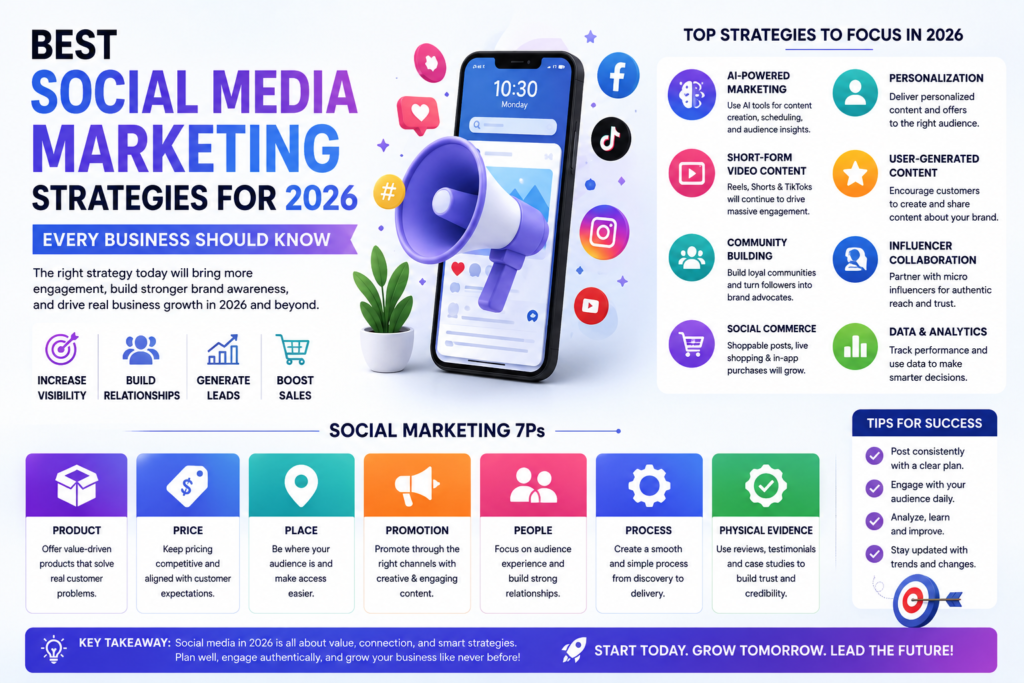
The 7Ps marketing mix framework (originally developed for traditional marketing) is highly relevant to social media marketing in 2026. Let’s break down each element with practical examples:
Product
What It Means: The product or service you’re offering. How does social media support it?
Example: A skincare brand uses Instagram Reels to showcase product demos, ingredient breakdowns, and before-and-after results. They also use UGC to show real customers using their products .
Price
What It Means: The cost of your product or service. How do you communicate value?
Example: A B2B SaaS company uses LinkedIn to share case studies showing ROI. They justify their pricing through thought leadership content that highlights the value they provide .
Place
What It Means: Where you sell and distribute your products.
Example: An e-commerce brand uses Instagram and TikTok Shop to enable in-app purchasing. Consumers don’t need to leave the app to buy .
Promotion
What It Means: How you communicate with your audience.
Example: A small business uses a mix of organic content, UGC, micro-influencer partnerships, and paid ads. They use their best-performing organic content as ads because the social proof is already there .
People
What It Means: Everyone involved in delivering your product or service.
Example: A coffee shop features its baristas on Instagram Stories, showcasing their personalities and expertise. They respond to DMs personally to build relationships .
Process
What It Means: The systems and workflows that deliver your product or service.
Example: A small business sets up a content calendar, uses a scheduling tool, and has a clear approval process to ensure consistency and speed .
Physical Evidence
What It Means: The tangible proof that your product or service exists and delivers value.
Example: A fitness brand shares photos and videos of customers achieving their goals. They also share behind-the-scenes content of their facility and equipment .
Common Social Media Marketing Mistakes to Avoid in 2026
Ignoring Analytics
The Mistake: Posting without tracking performance.
The Fix: Track metrics that actually matter:
- Link clicks
- Profile visits
- Direct messages
- Leads or sales (not just likes and impressions)
- Shares, saves, comments, and watch-time
Set up UTM tracking on every link you share and check your analytics weekly. Kill content formats that don’t move the right numbers—even if they get plenty of likes .
Over-Promotion
The Mistake: Constantly asking people to buy.
The Fix: Follow the 80/20 rule. Offer value first. Build trust before you pitch.
Inconsistent Posting
The Mistake: Posting sporadically.
The Fix: Consistency is the single most important factor in long-term growth . Use a content calendar and batch-create content to maintain a steady cadence.
Not Adapting to Platform Updates
The Mistake: Using the same strategy across all platforms.
The Fix: Algorithms change constantly. Stay updated on what each platform rewards (Reels on Instagram, Carousels on LinkedIn, Shorts on YouTube) and adapt accordingly .
Chasing Vanity Metrics
The Mistake: Obsessing over follower count and likes.
The Fix: Focus on engagement metrics that drive business results: shares, saves, comments, watch-time, leads, and sales .
Future of Social Media Marketing Beyond 2026
The landscape is evolving quickly. Here’s a glimpse of what’s coming:
AI Assistants
AI will become more deeply integrated into social platforms, from content creation to customer care. However, human oversight will remain essential as consumers become increasingly skeptical of AI-generated content .
Augmented Reality (AR) and Virtual Reality (VR)
Immersive experiences will become more common. Brands may offer virtual try-ons, 3D product previews, and interactive experiences directly within social apps.
Hyper-Personalization
Feeds will become even more tailored to individual preferences . Brands will need to understand their audience’s niche interests deeply and create highly relevant content.
Predictive Marketing
AI will predict what content will perform best before it’s even published. But as with all AI tools, human creativity and judgment will remain the critical differentiator.
Social SEO
Social search will continue to grow. Optimizing your social content for keywords will become as important as traditional SEO .
Conclusion
Social media marketing in 2026 is more challenging—and more rewarding—than ever before. The strategies that worked five years ago are largely obsolete. Today’s winners are:
- Focused: They dominate one or two platforms rather than spreading themselves thin .
- Authentic: They use AI as a tool, not a crutch, and maintain a genuine human voice .
- Engaging: They prioritize conversations, communities, and relationships over broadcasting .
- Video-First: They leverage short-form and long-form video to connect and educate .
- Data-Driven: They track metrics that matter and adjust their strategies accordingly .
The most important step? Start adapting now. The businesses that embrace these strategies early will dominate their niches.
Social media is a long game with short-term catalysts. Build a solid foundation, stay agile, and always keep learning. Your customers are waiting.
Frequently Asked Questions (FAQs)
Q1: How often should I post on social media in 2026?
A: Quality matters more than quantity, but posting more often improves visibility. Top accounts post multiple times per day across platforms. Start with a consistent cadence you can maintain—like once per day on your primary platforms—and increase as your capacity grows .
Q2: Is organic reach dead in 2026?
A: Organic reach is more challenging, but it’s not dead. Platforms like LinkedIn still offer strong organic reach. The key is creating high-quality, engaging content that platforms reward. You can also amplify your best organic posts with paid ads to maximize their impact .
Q3: Which social media platform is best for B2B businesses?
A: LinkedIn is the dominant platform for B2B. Its organic reach is currently strong, and it’s the primary network for professional networking, thought leadership, and lead generation .
Q4: How can small businesses compete with larger brands on social media?
A: Small businesses have advantages larger brands lack: agility, authenticity, and the ability to connect personally with their audiences. Focus on community-building, use UGC and micro-influencers, and be more human in your interactions. You can also localize your ads to compete cost-effectively .
Q5: How important is video content in 2026?
A: Video is non-negotiable. Short-form video (TikTok, Instagram Reels, YouTube Shorts) is the highest-reach format. Long-form video is also making a comeback as audiences seek deeper content. If you’re not investing in video, you’re falling behind .
Ready to Supercharge Your Social Media Strategy?
Social media marketing in 2026 is complex, but you don’t have to navigate it alone. Whether you need help with strategy, content creation, or analytics, our team of experts is here to help.
Contact us today for a free consultation and let’s build a social media strategy that drives real results for your business
you can visit to out another blog post on Top Digital Marketing Trends in 2026 Every Business Should KnowTop Digital Marketing Trends 2026