
Introduction
The digital marketing landscape is no longer just evolving; it is undergoing a fundamental transformation. In 2026, the rules have changed. It is a world where Artificial Intelligence (AI) is not just a tool but a companion in the consumer’s shopping journey, and where authenticity is the ultimate currency.
If you are a business owner, a startup founder, or a marketer, the strategies that worked even a year ago may now be obsolete. Consumers are drowning in an ocean of generic content, and they are demanding something real, something human, and something that truly understands them .
This comprehensive guide explores the top digital marketing trends in 2026 that every business must know. We will dive deep into actionable strategies, from optimizing for AI-powered search engines to leveraging the power of employee-generated content. Whether you are looking to stay ahead of the curve or just starting your digital journey, this guide will provide you with the insights and practical tips to thrive in 2026 and beyond.
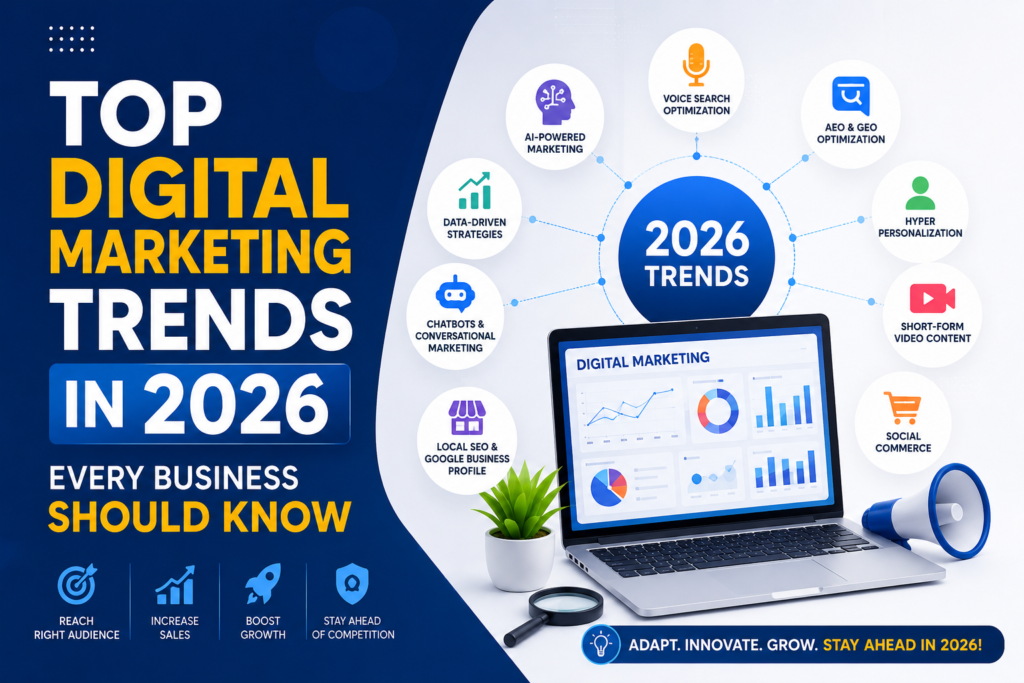
Top Digital Marketing Trends in 2026
AI-Powered Marketing
AI is no longer a future concept; it is the present reality driving the most significant changes in marketing. In 2026, AI is moving beyond simple automation to become a creative partner and a strategic advisor.
From Automation to Elevation
We are moving past the era of just using AI to generate more content. The focus in 2026 is on AI elevation—using AI to create better, more curated, and valuable content . It’s about leveraging AI to understand your audience deeply and deliver experiences that resonate, rather than just bombarding them with generic messages.
AI in Decision Making
AI is becoming the new gateway to consumer decisions. Consumers are using AI assistants like ChatGPT and Google’s Gemini to discover, compare, and even make purchase decisions . This means that your brand’s visibility depends on being the answer the AI gives to a user’s question. For instance, a consumer might ask, “What’s the best waterproof camera under 500 dollars?” and an AI agent will generate a direct answer, citing sources. If your product isn’t mentioned, you lose the sale.
Actionable Tips:
- Invest in AI tools that provide deep data analysis, not just content generation.
- Focus on AI prompts that drive creativity. Use AI to brainstorm unique angles for your campaigns.
- Ensure your content is structured so AI can easily understand and cite it (more on this in the AEO/GEO sections).
Voice Search Optimization
With the proliferation of smart speakers and voice assistants on mobile devices, voice search is a critical component of digital marketing in 2026.
Why Voice Search Matters
Voice search is the new default for many users because it’s faster and easier, especially on mobile. People speak in natural, conversational language when using voice search. The queries are often longer and more specific, known as long-tail keywords. For example, someone might type “best pizza near me,” but they’ll voice-search, “What’s the best pizza place open right now in my area?”
How to Optimize
- Target natural language and question-based keywords. Think about the questions your customers would ask and incorporate them into your content.
- Optimize for local SEO. Many voice searches are local. Ensure your Google Business Profile is accurate and complete.
- Create FAQ content. A well-structured FAQ page is a goldmine for voice search, as it directly answers common queries .
AEO (Answer Engine Optimization) & GEO (Generative Engine Optimization)
In 2026, the concept of Search Engine Optimization (SEO) has expanded to include Answer Engine Optimization (AEO) and Generative Engine Optimization (GEO) . While SEO was about ranking in a list of blue links, AEO and GEO are about ensuring your content is cited by AI-powered search engines as the authoritative answer to a user’s query.
What Are AEO and GEO?
The traditional customer journey (search, click, browse) is shifting to a direct-answer model. Consumers are no longer just searching; they are asking specific questions. AI engines like Google’s AI Overviews or ChatGPT generate a consolidated response. AEO and GEO are the strategies you use to become the source that is referenced in those AI-generated answers.
AEO focuses on directly answering user questions to be featured in “position zero” or answer boxes.
GEO is a newer concept that focuses on making your content discoverable and citeable by large language models (LLMs). It’s about being part of the AI’s “knowledge” to be recommended .
Is SEO Still Relevant for AI Search?
Yes. Google’s official guidance in May 2026 confirmed that AI features are “rooted in our core Search ranking and quality systems.” AEO and GEO are not a replacement for SEO; they are a natural evolution of it. The same fundamentals—great content, strong authority, and a solid technical foundation—are what matter for AI citation . In fact, 97% of CMOs reported a positive impact from AEO in 2025, and 94% plan to increase their investment in 2026 .
Actionable Tips:
- Forget the “hacks.” Google says you do not need special files like
llms.txt, to “chunk” your content into small pieces, or to rewrite everything to sound like a robot . - Create “non-commodity” content. This is the most important factor. Don’t just rehash what everyone else has said. Add a unique perspective, first-hand experience, and genuine expertise that an AI model cannot easily produce .
- Maintain clear technical structure. Ensure your site is fast, crawlable, and has a clear hierarchy.
- Stay up-to-date with structured data. While not required for AI citation, it’s a good practice for overall SEO and helps with rich results .
Hyper-Personalization
In the age of AI, generic marketing is dead. In 2026, hyper-personalization is the key to winning and retaining customers.
Why Hyper-Personalization is Key
Consumers are no longer impressed by basic personalization like “Hi [First Name].” They expect brands to understand their unique needs, preferences, and purchase history to deliver tailored experiences across every touchpoint. AI makes this possible at scale by processing vast amounts of data to predict consumer behavior .
Data is the Fuel
To deliver hyper-personalization, you need robust data. This is where first-party data is crucial .
Actionable Tip:
- Use AI-powered analytics to segment your audience not just by demographics but by behavior and intent.
- Personalize emails, website content, and product recommendations in real-time based on user activity.
- Use generative AI to create hyper-personalized ad visuals that speak directly to different customer segments .
Short-Form Video Marketing
Short-form video continues to dominate social media, making it one of the most essential digital marketing trends in 2026.
The Power of Short Video
Platforms like TikTok, Instagram Reels, and YouTube Shorts are the primary source of entertainment and information for millions. These formats are highly engaging and have the power to make a brand go viral almost instantly. In India, the growth of short-form video is a key driver of digital advertising growth .
How to Use Short-Form Video
- Create authentic, behind-the-scenes content. Show the human side of your brand.
- Educate your audience. Short, valuable tips and how-to content are highly shareable.
- Embrace trends and challenges. Participate in community-driven trends, but with a genuine touch .
Influencer Marketing Evolution
The era of “mega-influencers” with millions of followers is giving way to a more nuanced and trust-based approach. Influencer marketing is shifting from chasing mega reach to building micro-trust .
The Rise of Micro and Nano Influencers
Businesses are increasingly partnering with micro-influencers (10k-100k followers) and nano-influencers (1k-10k followers) who have highly engaged and loyal communities. These influencers are seen as more authentic and relatable, making their recommendations more powerful.
Creator and Content Authenticity
With the rise of AI-generated content, ensuring the authenticity of creators and their content is becoming a priority for brands. There is a growing need to verify creator identities and combat deepfakes to protect brand trust . This has led to budgets shifting more toward creators who provide validated, trustworthy content.
Actionable Tip:
- Focus on micro-influencers who are a perfect fit for your niche rather than paying a premium for a single celebrity post.
- Build long-term relationships with creators who genuinely love your brand.
- In India, regional creators are becoming extremely powerful for reaching localized audiences .
First-Party Data Strategies
With the phasing out of third-party cookies and increasing privacy regulations like India’s DPDP Act, first-party data has become the most valuable asset a marketer can possess.
Why First-Party Data Matters
First-party data is information you collect directly from your audience (e.g., through website interactions, email signups, and purchase history). This data is reliable, owned by you, and allows for better personalization without relying on invasive tracking .
Implementing a Data Strategy
- Focus on collecting data ethically. Be transparent with users about what you’re collecting and why.
- Build a strong CRM system. Centralize all your customer data to get a 360-degree view of your customer.
- Use “little treats” and loyalty programs. These encourage users to willingly share their data in exchange for value .
Conversational Marketing and Chatbots
Conversational marketing is the new front line for customer engagement. In 2026, chatbots have evolved into sophisticated, AI-powered conversational agents.
The Shift to Conversational Commerce
Consumers are moving toward conversational ecommerce, where they can discover and purchase products directly within a chat interface. AI-powered shopping agents are becoming constant companions in the consumer’s journey, offering recommendations and answering questions in real-time .
Leveraging Generative AI
Platforms like Instagram are seeing creators use agentic AI to engage with fans through DMs at scale, driving community and sales . This level of personal interaction was impossible without AI.
Actionable Tip:
- Implement an AI-powered chatbot on your website and social channels.
- Use these bots to handle routine queries, provide product recommendations, and even complete transactions, freeing up your human team for more complex issues.
Local SEO and Google Business Profile
For businesses that serve a local community, local SEO has never been more important. With the rise of voice and AI search, your Google Business Profile (GBP) is often the first thing a potential customer sees.
Local SEO in the AI Era
AI search engines pull a significant amount of information from structured data sources, including your GBP. Keeping this information accurate and current is critical for being cited in local search results .
Actionable Tip:
- Optimize your GBP with complete, up-to-date information: address, phone number, hours, photos, and services.
- Actively manage your reviews and respond to them.
- In India, with a massive mobile-first user base, local SEO is a powerful growth driver .
Social Commerce
Social commerce—the ability to buy products directly within a social media platform—is booming. It shortens the customer journey from discovery to purchase, making it seamless for the user.
Why Social Commerce is a Game-Changer
Platforms like Instagram and TikTok are creating in-app shopping experiences that mirror ecommerce sites, complete with storefronts and payment processing. In India, ecommerce and quick-commerce platforms are becoming key advertising channels, with commerce advertising expected to grow significantly .
Actionable Tip:
- Set up a store on platforms like Instagram and Facebook.
- Create shoppable posts and videos to turn engagement directly into sales.
- In India, list your products on ecommerce platforms like Amazon and Flipkart, and explore quick-commerce for fast-moving goods .
Omnichannel Marketing
Consumers interact with brands across multiple channels—social media, websites, email, stores, and more. Omnichannel marketing is the practice of creating a seamless and consistent experience across all these touchpoints.
The Goal of Omnichannel Marketing
Your goal is to provide a unified brand experience. A customer might discover your brand on a podcast, then see a YouTube ad, and finally make a purchase after clicking an email. The experience should feel connected and consistent at every stage .
Actionable Tip:
- Map your customer’s journey and identify all the channels they use.
- Integrate your data and tools to ensure a single view of your customer across all platforms.
- In India, it’s vital to integrate platforms like quick commerce for demand fulfillment .
Interactive Content
Static content is no longer enough to capture attention. In 2026, interactive content is a key tool to engage audiences and gather data.
Examples and Benefits
- Quizzes, Polls, and Calculators: These are highly shareable and provide immediate value.
- Interactive Videos and AR Filters: These offer immersive brand experiences.
- Benefits: They drive higher engagement, increase time spent on your site, and provide valuable first-party data.
Actionable Tip:
- Add an interactive element to your blog posts or social media feeds.
- Create a fun quiz that recommends a product to your customers.
Automation and Predictive Analytics
Marketing automation is moving from simple email drip campaigns to complex, AI-driven workflows. In 2026, we are seeing the rise of agentic AI, where AI systems can act autonomously to achieve a goal.
Agentic AI and Automation
Instead of just automating a task, you define an outcome (e.g., “Maximize ROI for Q3”), and multiple AI agents work together to make it happen . This is revolutionizing marketing operations, allowing for real-time campaign optimization and personalized communication at massive scales .
Predictive Analytics
By analyzing historical data, AI can predict future customer behavior, such as churn risk or likely next purchase. This enables marketers to proactively engage customers with the right message at the right time.
Actionable Tip:
- Explore AI tools that offer predictive analytics to anticipate your customer’s needs.
- Use automation to re-engage customers at risk of churning.
Sustainable and Ethical Marketing
Modern consumers, especially Gen Z and Millennials, are making purchasing decisions based on a brand’s values. Transparency, sustainability, and ethical practices are non-negotiable.
Why it Matters
Brands that are seen as authentic and purpose-driven win customer loyalty. The rise of “AI slop” has made consumers hyper-aware of inauthentic content, and they are actively seeking out brands that feel genuine and human .
Actionable Tip:
- Be transparent about your supply chain, materials, and business practices.
- Don’t just talk about your values; demonstrate them with action.
- In 2026, “trying” is cool. Show the effort, care, and passion that goes into your products .
Digital Marketing Trends in India
India is a unique and incredibly vibrant digital market. Understanding the specific trends in India is crucial for businesses looking to succeed there.
Emerging Opportunities for Indian Businesses
Market Growth
India’s advertising market is projected to reach a staggering $22.5 billion in 2026, driven almost entirely by digital adoption, AI, and ecommerce . Digital advertising is the primary engine of growth.
Mobile-First and Quick Commerce
India is a mobile-first nation, with most users accessing the internet via their smartphones. This makes mobile optimization non-negotiable. Furthermore, the explosive growth of quick-commerce platforms like Blinkit, Zepto, and Instamart is collapsing the traditional marketing funnel. Discovery and purchase are happening in minutes .
Vernacular and Regional Content
Consumers in India are consuming more content in their native languages. Brands that invest in vernacular storytelling and regional creator partnerships have a significant competitive advantage . Trust is built through cultural proximity and relatability.
The Role of AI
Indian consumers are adopting AI technologies faster than many global markets because they are highly convenience-oriented. They don’t care if a technology is revolutionary, only if it saves time and money . This creates a huge opportunity for brands to integrate AI into their customer experience.
Actionable Tips for India:
- Go mobile-first. Ensure your website and content are optimized for smartphones.
- Explore quick commerce partnerships. If you sell fast-moving consumer goods, this is a must.
- Hire regional creators. Build trust by creating content in local languages and cultural contexts.
Digital Marketing Trends for Small Businesses
You don’t need a massive budget to leverage the latest digital marketing trends. Here are some budget-friendly and easy-to-implement tactics for small businesses.
Budget-Friendly Strategies
Content is Your Superpower
In the era of AI slop, authentic human content is your greatest asset. Focus on telling your story. Share behind-the-scenes photos, write blogs from your personal experience, and use video to connect with your customers.
Leverage Micro-Influencers
Instead of paying for expensive ads, partner with a few micro-influencers in your community or niche. They are often more affordable and can provide a much better ROI for a small business.
Optimize Your Google Business Profile
It’s free and powerful. Make sure your GBP is complete and active to dominate local search results, which is crucial for small businesses.
Build a Community
Platforms like Reddit, Discord, and WhatsApp communities are free and can be powerful for building a loyal tribe of customers and advocates .
Tools and Platforms Suitable for Small Businesses
- Canva: For creating high-quality visuals and short-form videos.
- Buffer or Hootsuite: For managing and scheduling social media posts.
- Mailchimp: For building an email list and simple automation.
- Google Analytics: For understanding your website traffic.
Digital Marketing Trends and Strategies for Business Growth
Implementing the latest trends is the first step; building a strategy around them is what drives growth.
Practical Implementation Tips
- Audit Your Current Content: Look at your existing content. Is it “commodity” content, or does it offer a unique perspective? Update it to add genuine expertise.
- Shift Your Focus from Clicks to “Share of Model”: Your new KPI is how often you are cited in AI-generated answers. Invest in AEO and GEO by creating authoritative, structured content .
- Empower Your Employees: As noted in the trends, employees are powerful brand architects. Encourage them to share their experiences and expertise on social media. This is one of the most authentic and cost-effective strategies available .
- Get Comfortable with AI, but Stay Human: Use AI for efficiency, but always add a human touch. Edit AI-generated content, add your personal stories, and engage with your audience authentically .
Step-by-Step Recommendations
- Month 1: Set up a robust data collection and CRM strategy. Start mapping your customer journey across all channels.
- Month 2: Audit and refresh your existing content with a focus on E-E-A-T and “non-commodity” value.
- Month 3-6: Launch a pilot AEO project. Target 5-10 key questions your customers ask and create “answer-centric” content. Partner with your team to launch an employee advocacy program.
- Ongoing: Continuously monitor your performance across traditional search and AI platforms. Adjust your strategy based on real data. Engagement from AI channels often converts at a higher rate, so it’s worth the investment .
Digital Marketing Trends 2026 Report: Key Statistics and Insights
Here is a snapshot of key statistics from the 2026 digital marketing landscape.
Common Mistakes Businesses Should Avoid in 2026
- Creating “Commodity” Content: Mistake: Writing generic articles that rehash what’s already out there. Solution: Always add a unique perspective, original research, or a personal story. Be the expert .
- Ignoring AEO and GEO: Mistake: Only optimizing for traditional search rankings. Solution: Structure your content to answer user questions clearly and be a source of authority for AI models.
- Jumping on Every Trend in a Sloppy Manner: Mistake: Trendjacking—trying to force your brand into a viral trend it doesn’t fit. Solution: Participate in trends only if they are culturally relevant to your brand and audience. Add genuine value .
- Overlooking the Power of Employees: Mistake: Keeping your social media strategy entirely corporate. Solution: Empower your employees to be brand advocates. Their content is more trusted and often performs better .
- Underestimating the Importance of First-Party Data: Mistake: Relying on dying third-party cookies. Solution: Build a robust first-party data strategy through valuable offers, subscriptions, and loyalty programs .
Future of Digital Marketing Beyond 2026
What does the horizon look like?
- Agentic AI Will Rule: Marketing will transition from a human-led, task-based process to an agent-led, human-governed one. Marketers will become “orchestrators” of AI systems .
- Ambient Computing: Smart devices (wearables, sensors) will become a major channel for brand engagement, creating passive, context-driven interactions .
- The Winner Will Be the Human Touch: As AI becomes ubiquitous and content generation becomes cheaper, the most valuable asset a brand can have is its humanity. Creativity, genuine storytelling, and a soulful brand presence will be the ultimate differentiators .
Conclusion
2026 is a pivotal year in digital marketing. The trends we’ve explored—from AI-powered personalization and the rise of AEO/GEO to the desperate consumer need for authenticity—point to a clear conclusion:
To win in 2026, you must be discoverable by AI, but you must be loved by humans.
It is the perfect marriage of data-driven technology and human-centric creativity. The business that masters this balance will not just survive but thrive.
Now is the time to act. Don’t wait until your competitors have a head start. Audit your content, build your data strategy, and start creating content that adds real, undeniable value to your audience.
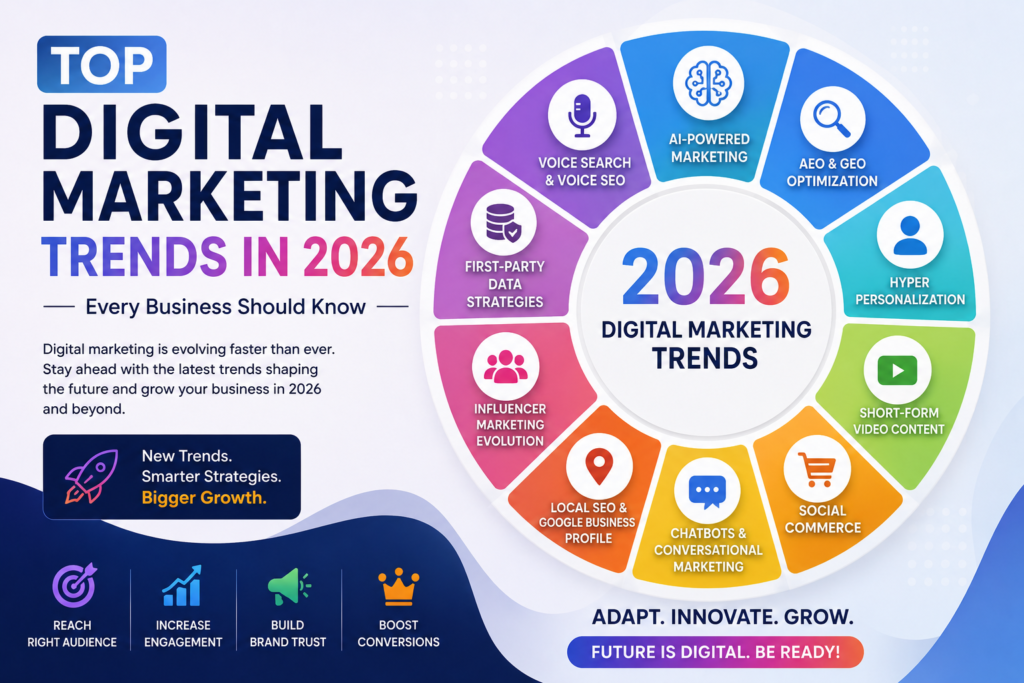
Ready to conquer the digital marketing world in 2026?
Navigating these trends can be overwhelming. At Vayusha Digital Marketing, we specialize in turning these cutting-edge trends into actionable growth strategies for your business. From implementing AEO and GEO strategies to crafting authentic, human-centric content that cuts through the AI noise, our expert team is here to help you succeed.
Contact Vayusha Digital Marketing today for a free consultation. Let’s build the future of your brand together!
Frequently Asked Questions (FAQ)
- What are the latest digital marketing trends for 2026?
The latest trends include AI-powered marketing, hyper-personalization, short-form video, and a strong focus on AEO (Answer Engine Optimization) and GEO (Generative Engine Optimization). Brands are also focusing on building trust through authentic content and employee advocacy . - What is AEO and GEO in digital marketing?
AEO (Answer Engine Optimization) and GEO (Generative Engine Optimization) are strategies to ensure your content is cited by AI-powered search engines like Google’s AI Overviews or ChatGPT when they generate direct answers to user queries. It focuses on authority and structured information over just keywords . - How can small businesses leverage digital marketing trends on a budget?
Small businesses can focus on creating authentic, behind-the-scenes content, partnering with micro-influencers for better ROI, and optimizing their free Google Business Profile for local search. Building a community on platforms like Reddit or WhatsApp is also powerful and low-cost . - What are the key digital marketing trends in India for 2026?
India’s market is characterized by a mobile-first user base, explosive growth in quick commerce, and the rising power of regional language content. AI adoption is high as consumers prioritize convenience, and commerce media is a booming sector . - How is AI changing digital marketing in 2026?
AI is becoming a “shopping companion” and is increasingly used for deep data analysis, hyper-personalization, and automating complex campaign management. The focus is shifting from using AI for mere automation to using it for “elevation”—creating better content and experiences . - Why is authenticity so important in the 2026 digital marketing trends?
With the internet flooded by low-quality, AI-generated content known as “AI slop,” consumers are craving genuine, human connection. Brands that show their soul, share real stories, and demonstrate effort are earning trust and winning customer loyalty . - How should businesses adapt their SEO strategy for 2026?
Businesses should stop chasing “AI hacks” and double down on Google’s core fundamentals: creating “non-commodity” content that adds unique value, maintaining a clear technical structure, and ensuring their website is authoritative and trustworthy . - What is the significance of first-party data in 2026?
With the decline of third-party cookies and new privacy laws, first-party data (data you collect directly from your customers) is your most valuable asset. It allows for effective personalization and building stronger customer relationships without invading privacy
if you love this then please read our another blog :Top Digital Marketing Trends in 2026 Every Business Should Know